As West Ham head into their first European semi-final since 1976, Callum Goodall and Jack Elderton have gotten together to preview the tie and provide a closer insight into how the opposition function, who their best players are, and how we can break them down.
Eintracht Frankfurt, coincidentally the same opposition that West Ham faced in that ‘76 Cup Winners Cup semi-final, generally line-up in a 3421 formation; a system they returned to when Austrian manager Oliver Glasner gave up on using a four in defence after an abysmal start to the campaign with no wins from their first eight fixtures in all competitions. And The Eagles have seen an upturn in results since then with the talent in the squad maximised by this system.
Frankfurt’s 3421 is very different to what we’ve encountered so far in the knockout rounds of the Europa League. Generally less keen to have the ball and more intent on pressing aggressively and transitioning rapidly, the Germans play a completely different brand of football to that which we faced in the ties against Sevilla and Lyon. Where those teams wanted to dominate possession and build slowly, Frankfurt will instead be keen to hit the channels from deep or build quickly on the flanks before looking to switch the play to make maximum use of their width.
And this is something that really is key to all areas of Frankfurt’s game. Using a 541 low block shape when defending and a 325 shape when attacking, Glasner’s side are able to maintain their width on both sides of the pitch at all times and make use of the pace they have in wide areas.

Their main man in these wide areas, and arguably their most important player, is Filip Kostic, whose 7 goals and 13 assists in the Bundesliga and Europa League account for 28.8% of the 59 goals that Frankfurt have scored in those competitions. Structurally, he is integral, pinning opposition defenders high and wide and hugging the left-side touchline when play is out on the right, awaiting a lofted switch pass before using his blistering pace to get in behind. As is evidenced by his 13 assists, it’s his creativity that we ought to be most wary of, and this is exemplified by Kostic’s underlying metrics, with the Serbian wing-back averaging the highest number of crosses per 90 in Europe’s “Top 5” Leagues (8.3) whilst boasting an equally impressive success rate (38.3%). For reference, Kostic is performing at a higher level than both Cresswell (3.1 per 90 at 26.1%) and Coufal (3.9 per 90 at 31.7%) in the crossing department, whilst Johnson, somewhat surprisingly, is a less frequent but more accurate crosser of a ball (3.3 per 90 at 39.5%) – proof that data really isn’t everything.
With Zouma unlikely to feature on Thursday evening, the thought of an aerial bombardment from our right-hand side is a daunting one. Even more concerning given some of the goals we have conceded this season and our tendency to defend deep into our own area, is that a significant number of Kostic’s crosses are fizzed cutbacks to late arriving attackers. All this is to say that Soucek, Coufal, and Johnson, assuming Moyes fields him as a right-sided centre-back, are going to need to communicate effectively throughout the game to minimise Kostic’s involvement. One positive, however, is that when Kostic is able to whip a ball into our box, whether it’s a lofted cross or a low ball to a runner, we have Craig Dawson in there, a defender who wins defensive headers and throws his body in front of shots for fun.
For all of Kostic’s talent, he is a great example of a player who Glasner is getting more out of by utilising a system that brings out the best of the Serb. One of the other key enabling factors for Kostic’s performances is the exceptional form of Frankfurt’s creative hub, Jesper Lindstrom. Since arriving from Brondby in the summer for £6.3m, Lindstrom has gradually established himself as one of the first names on Glasner’s teamsheet, and his importance to Frankfurt’s style of play is often overlooked. Compared to Kostic, a “wing-back”, Lindstrom’s five goals and six assists in all competitions seems like an unimpressive return, but these numbers don’t even begin to paint a picture of Lindstrom’s importance to Die Adler. One metric that really stands out is key passes per 90, with the Dane creating an average of two goalscoring opportunities in each Bundesliga game he’s featured in this season, a level of productivity that would cause problems for any defence. He’s also a solid ball-carrier, averaging 2.3 progressive carries per 90 this season, though only succeeding in 42.4% of his 4.7 dribble attempts. It’s his 1.3 carries into the penalty area that could prove to be an issue for us though, particularly if his quick feet come up against Ajibola Alese or a much slower, back-pedalling Aaron Cresswell. With accomplished ball-carriers like Kostic and Lindstrom on the pitch, Moyes might remind our defence to keep their hands by their sides.
The most striking feature of Lindstrom’s game, however, is his defensive contribution, particularly in the context of a Frankfurt side whose main objective is to win possession in the final third. It’s impossible to discuss this side of Lindstrom without giving credit to Frankfurt’s recruitment team, who have understood and acknowledged Glasner’s pressing philosophies and proceeded to buy him an absolute pressing freak. In the Bundesliga this season, Lindstrom ranks in the 97th percentile (or, in other words, in the top 3%) of attacking midfielders and wingers for pressures in the final third, with an average of 9.6 per 90. He also ranks in the top 6% for total pressures per 90 (22.8) and the top 10% for interceptions (1.9). Most impressively, 63.5% of Lindstrom’s 4.1 ball recoveries per 90 happen in the opposition half. That’s 2.6 times in every game that Lindstrom wins the ball back in the opposition half, which, when you consider his creativity and Frankfurt’s danger on the counter, is a frightening thought. A right-sided attacking midfielder that can carry the ball on the counter, create chances for his teammates, win back possession high up the pitch, chip in with goals, and carry out complex pressing philosophies? Sounds like Moyes’ perfect signing, which is interesting, because StatsBomb identify Jarrod Bowen as being the most stylistically similar player to Lindstrom in Europe’s “Top 5 Leagues”. One to watch.
Clearly the wide areas are crucial to how Glasner wants his team to play, but Frankfurt also have plenty of talent in the centre of the pitch too, and without Rafael Santos Borre their front three simply could not function. While the Colombian is yet to replicate the prolific form (0.83 G+A per 90 in 2019-20) that earned him a move from River Plate to Frankfurt, he is undoubtedly one of the most useful strikers you could find at the level below the very top, and is actually someone I’d advised us to sign back in the summer when he was available on a free. Since then, he’s put in a shift for Glasner, bagging nine goals and laying on five assists for his teammates in a season where scoring hasn’t come easy for Frankfurt. Given that this is his first season in Germany, that he’s currently underperforming his 0.35 xG per 90 by 0.06, and that 49.6% of his shots hit the target, I’d only expect Borre to get better.
Much like Lindstrom though, it’s Borre’s work rate that will please both his manager and the Frankfurt faithful. The man is an absolute workhorse, leading the Bundesliga’s pool of strikers in pressures per 90 (25.8) and pressures in the attacking third (13.2), whilst ranking 2nd for successful pressures per 90 (7.75), just behind Youssef Poulsen (7.83). And, when he’s not winning the ball back himself, his 83.2% short passing accuracy means he’s more than capable of receiving the ball in transition before laying it off to a countering teammate. All in all, we can expect Borre to put our makeshift backline under constant pressure for the full 90 minutes, which, given our general lack of press-resistant defenders, could be problematic.
Speaking of press-resistance, one definite positive ahead of the first leg is the absence of Frankfurt’s French colossus at the back, Evan N’Dicka. N’Dicka, who has been linked with West Ham in recent weeks, is having an incredible season, winning 66.6% of his defensive duels, 61.4% of his aerial duels, and completing 87.4% of his passes. A solid, young, left-footed, progressive centre-back, N’Dicka is unsurprisingly crucial to the way that Frankfurt set-up off the ball. Keen to press aggressively in the wide spaces, Frankfurt have made great use of N’Dicka’s recovery pace and strength in the tackle by sending him forward alongside Kostic to deny the space for opposition wingers to get moving at any pace; Almany Toure performs a similar function, although less remarkably, alongside Ansgar Knauff on the other side of the defence.
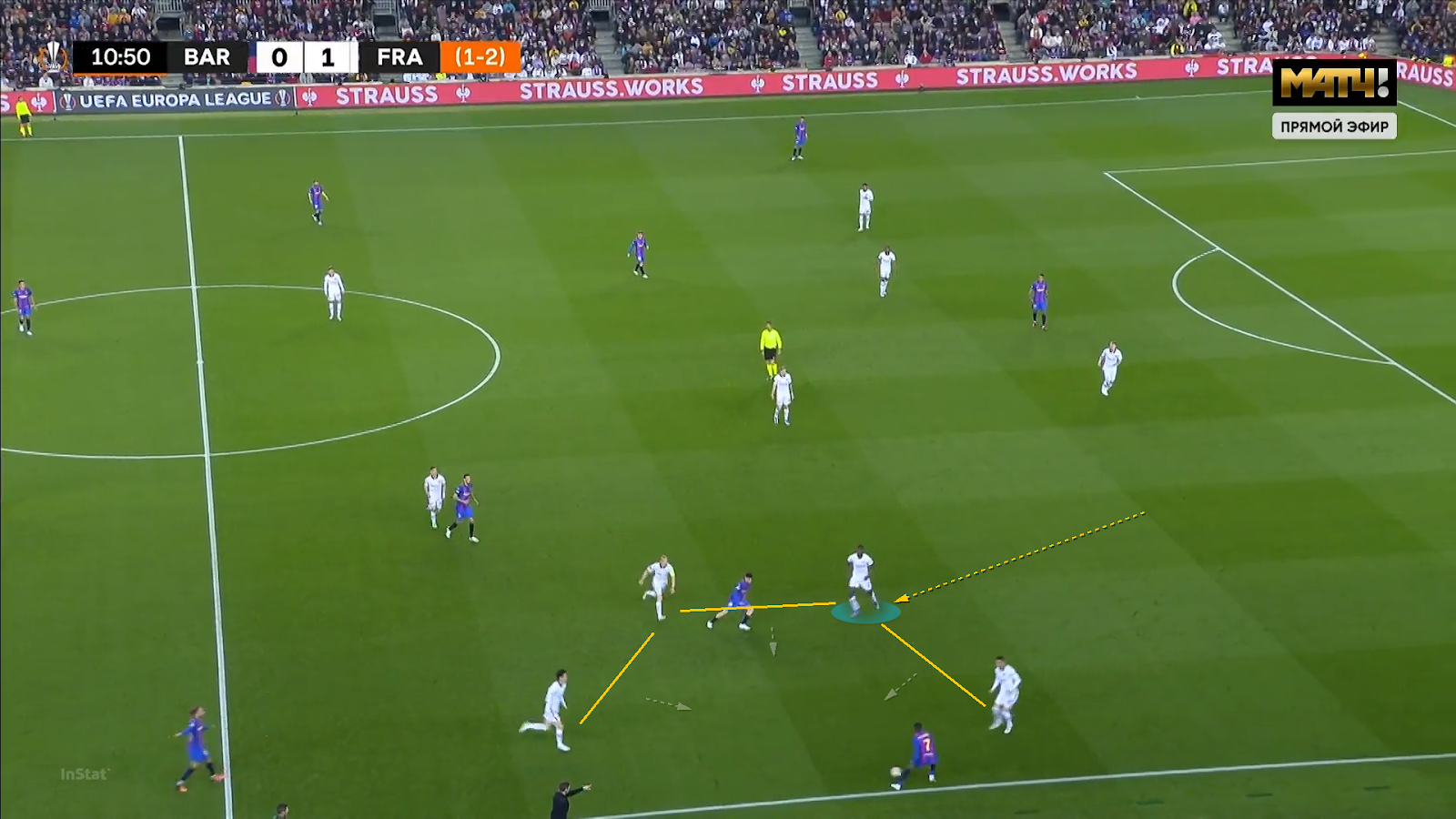
Missing N’Dicka will have a big impact on the way that Frankfurt are able to press in wide areas with 38-year-old Makoto Hasebe the most likely candidate to replace him in the defence. Hasebe obviously doesn’t have the same explosive physical profile to carry out such an aggressive defensive approach.
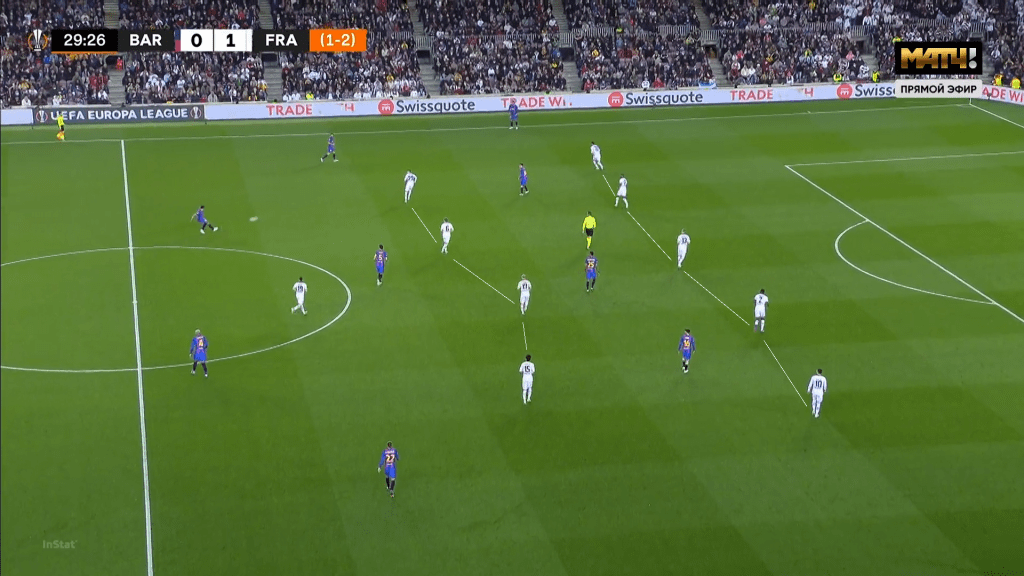
As a result, it’ll be interesting to see how Frankfurt might adjust their pressing structure overall. Against Barcelona, both central midfielders, Sebastian Rode and Kristijan Jakic were happy to commit high up the pitch and expose large spaces between the midfield line and the sometimes isolated central centre-back Martin Hinteregger.

This approach was entirely geared to stop Barcelona’s talented players in central midfield from being able to turn in possession, face forwards and play passes that could threaten Frankfurt between the lines. Barcelona’s 433 shape ended up playing into Frankfurt’s hands in this respect as the aggressive press funnelled the ball into wide areas where Toure and N’Dicka were able to force turnovers. And without a #10 or striker comfortable dropping off and receiving, Pierre-Emerick Aubameyang’s game is much more about playing off the last line and threatening in behind and in the box, Barcelona were unable to exploit the large spaces exposed by Frankfurt’s high pressing structure.

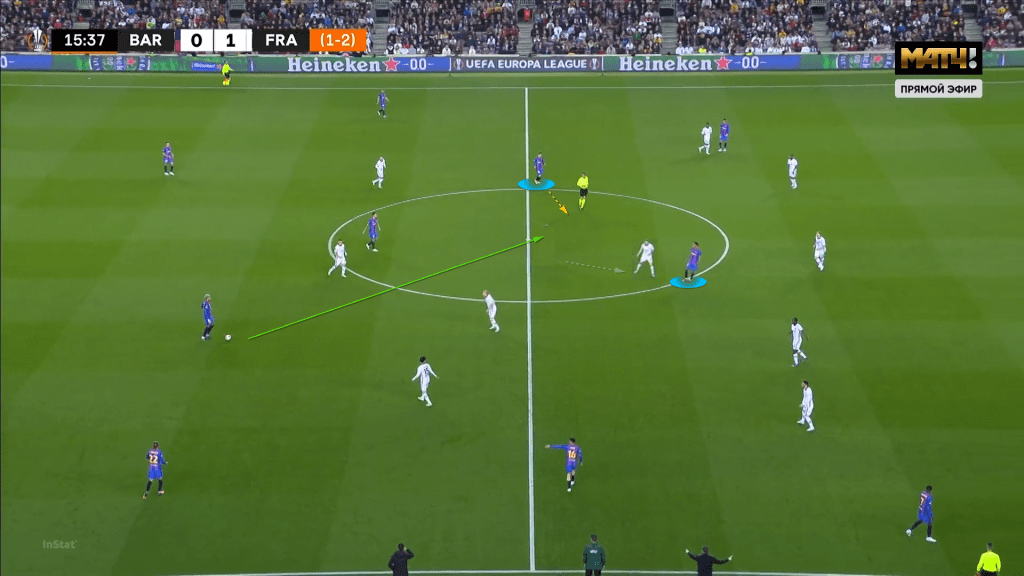
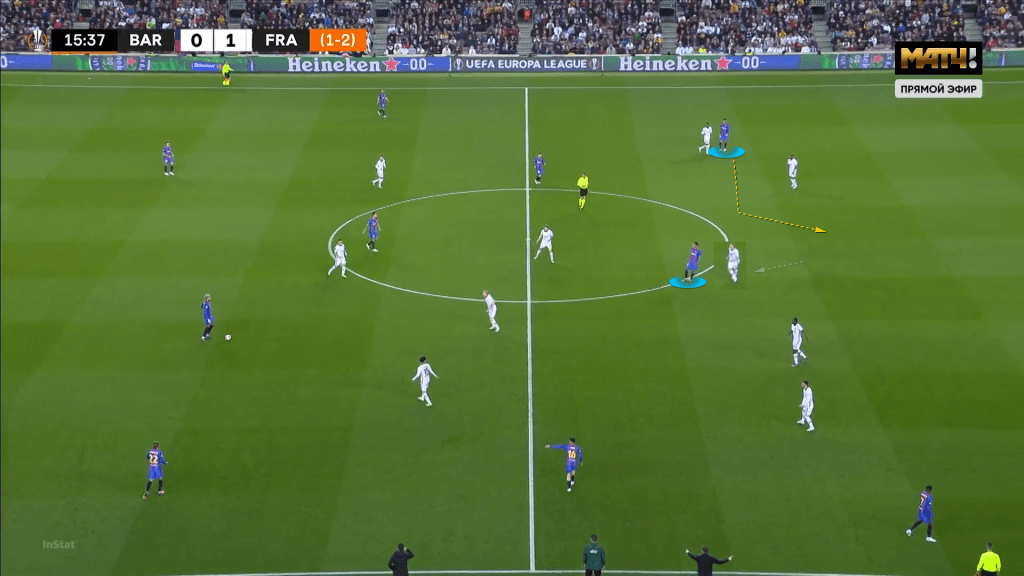
Assuming Frankfurt will try to deploy a similar off the ball structure against us on Thursday night, regardless of the potential issues with Hasebe lacking the pace to truly contribute positively, it’s imperative that we look to get the ball into the space behind the midfield two. Turning in the space between Hinteregger and the midfield is the most obvious way to threaten Frankfurt and with Hinteregger likely to be flanked by Toure and Hasebe, The Eagles’ defensive trio lacks any real quality 1v1 in duels versus dribblers at pace with all three defenders more suited to aerial duels or advantageous duels where they can use their physical profiles to force turnovers.
Jarrod Bowen and Manuel Lanzini will likely both be key in this area. Lanzini for his ability to find positive spaces between the lines and play calmly and incisively and Bowen for his carrying ability at pace.
The atmosphere around Frankfurt’s Europa League campaign is different to that which we’ve faced in the recent knockout rounds. In many ways, Frankfurt aren’t dissimilar to us. An incredibly well supported team that has consistently underachieved on the pitch, this year’s Europa League campaign represents a huge opportunity for the club and their passionate fanbase will be keen to play their part in making memories that will be treasured immensely for many years to come.
This is a different challenge. One where this West Ham side will once again have to assert themselves on the tie but will have to play with a little more intelligence to understand the speed with which the balance of the game can tip. Sevilla and Lyon required immense focus off the ball and then accuracy in possession. Here, our defensive focus will have to be strong on the ball with players needing to react quickly to stop Frankfurt’s rapid transitions.
For an even more in depth breakdown of tonight’s fixture, tune into the latest KUMB Podcast where Jack and Cal joined Chris to explore how West Ham must play to break down Glasner’s Frankfurt side.
 Jack Elderton