This January Callum Goodall and Jack Elderton have gotten together to profile one player a day from a list of players that West Ham could sign throughout the transfer window.
Callum Goodall is a data and recruitment specialist who you may know from his radar charts and megathreads on Twitter where he has produced an excellent scouting series taking a look at players that West Ham could, or should, invest in. We’re lucky to have him for now before he’s snapped up by the club itself.
Jack Elderton is a player performance analyst specialising in roles and tactics who has taken over production of the recently renewed KUMB Podcast. Here you can find Cal and Jack talking in more depth about West Ham’s form, tactics and transfers each week alongside our match reporter Chris “Wilko1304” Wilkerson.
Listen back to the latest episode here.
Arthur Cabral is a physically imposing Brazilian striker playing in the Swiss League for Basel where he has scored 27 goals in 31 games this season.
Arthur Cabral cost Basel just £5.4m when he arrived in Switzerland permanently after spending the 2019-20 season on loan from Palmeiras. They’ll be counting themselves very lucky now as his name is surely being thrown around in recruitment departments throughout Europe given his exploits so far this term.
Beginning his career in Palmeiras’ youth teams before ultimately being deemed not good enough for Brazil’s most successful club and getting released to Serie B club Ceara, Cabral would find himself with a big point to prove. And after playing a bit-part but relatively successful role as an 18 year-old in Ceara’s promotion push, he would go on to become the main man in their first season back in the top-flight since 2010-11, scoring seven goals in 31 games and doing just enough to keep the Northeastern club up.
That was enough for Palmeiras who paid £900,000 to extract Cabral from Ceara and return him to Sao Paulo. Though, much like before, he wouldn’t make the squad regularly as more proven strikers like Deyverson and Miguel Borja were consistently preferred up-front. And after only appearing once in what would feel like a wasted season, Cabral would make his move to Basel on loan.
Here he very quickly became the centre of attention again as Basel threw him straight into the starting lineup and Cabral responded strongly with 18 goals and three assists. Keen not to make the same mistake again, Palmeiras accepted Basel’s small offer and Cabral made the move to Switzerland permanently.
Since then, it’s been nothing short of a whirlwind of success for the Brazilian. 20 goals and two assists in 2020-21 followed by his remarkable return of 27 goals and five assists so far this season.
Almost exclusively deployed as a lone striker in Basel’s 4231 system, Cabral loves to drop deep to draw out the opposition defence before quickly interchanging with teammates and turning to use his pace to make runs in behind. When Basel opt to use him in possession, he is often able to utilise his big frame to draw in opposition players and create space for others before shifting the ball on. He’s also happy to pull out wide and make himself a nuisance with runs into the channels and has a fiercely powerful shot off his right-foot when the opportunity arises.
Perhaps most pleasingly, Cabral is yet to have a single serious fitness issue in his career thus far. His injury record is virtually spotless.
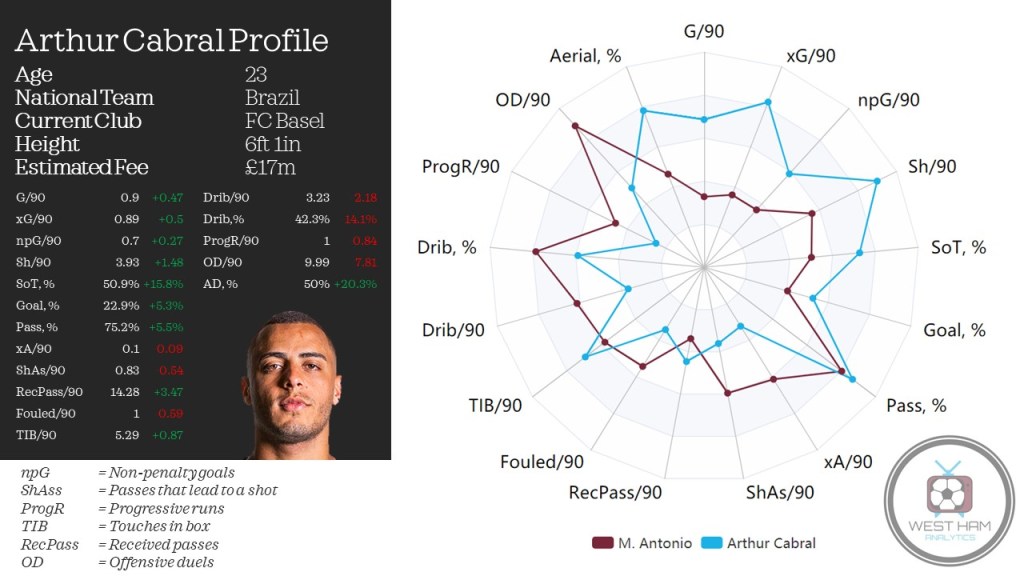
Of course, every free-scoring forward should be approached with caution, as it’s entirely possible that such a rich vein of form could just be a purple patch – hello Boulaye Dia, we haven’t forgotten about you. There is little cause for such concern with Cabral though, whose goal tally has consistently improved season-on-season and has always been roughly in-line with his xG. In 2020-21 for example, Cabral had an xG of 19.47 and scored 20 goals. This season, he has an xG tally of 26.67 and 27 goals – call that growth.
His goal-scoring prowess is further backed-up by the fact that 50.8% of his 3.93 shots per 90 have been hitting the target, and 22.8% of them have turned into goals. To put this into context, Antonio’s goal conversion rate this season is 15.2% and only 32.6% of his 2.35 shots per 90 have hit the target – these aren’t terrible numbers but Cabral is performing at a higher and more consistent standard.
Cabral is also averaging 5.2 touches in the penalty area per 90, 0.8 touches more than Antonio has been managing. Given how frustrating the latter’s positioning in the box has been in the last couple of months, Cabral’s instinctive ability to occupy Sam Allardyce’s POMO (Position Of Maximum Opportunity) could be the antidote to our exasperation.
The only drop-off we should expect to see from Cabral is around his ball-carrying. Unlike Antonio, Cabral is not a converted winger, and as such he is much less confident charging up the pitch with the ball and taking on his man. Antonio averages 5.57 dribbles per 90 and beats his man 56.9% of the time, whereas Cabral only attempts 3.23 dribbles with a success rate of 42.3%. Similarly, Cabral only makes one progressive run per 90, whereas Antonio is averaging 2.2 this season. Honestly though, a striker whose heatmap is largely central and situated in and around the box is arguably what we need on our counters, someone with decent hold-up-play who can lay it off to breaking players and make a run into the box.
We hear you though; Ajeti played for Basel, right? Yes, he did. And Ajeti scored loads of goals too didn’t he? Not like this. Ajeti had steady returns in Switzerland, not the exploding returns of Cabral. And while it may have seemed like a high-risk move at the time, the benefit of signing young players from lesser-known leagues is that you can often recoup lots of the value, even when it goes dramatically wrong.
Ajeti barely played for us after he arrived, we had a number of other strikers on the books and at fourth in the pecking order it was hard for him to work his way in. And despite this, we still managed to recoup half of what we paid for him when we sold him to Celtic.
If we were to bring Cabral in, he’d be joining as a top young Brazilian talent to be the second-choice striker in East London. Opportunities, you’d hope, would be more plentiful.
Jack’s Rating: B+
One of the better names on the market with him playing in a less reputable league minimising the fee. His positive form as a lone striker in the same system that we use is a huge benefit.
Callum’s Rating: A
Undoubtedly one of the best strikers on our reported shortlist and surely the best option in terms of value for money. He has all the technical qualities that we would want in a striker, as well as the physical attributes to play in the Premier League.
 Jack Elderton